About the Lab
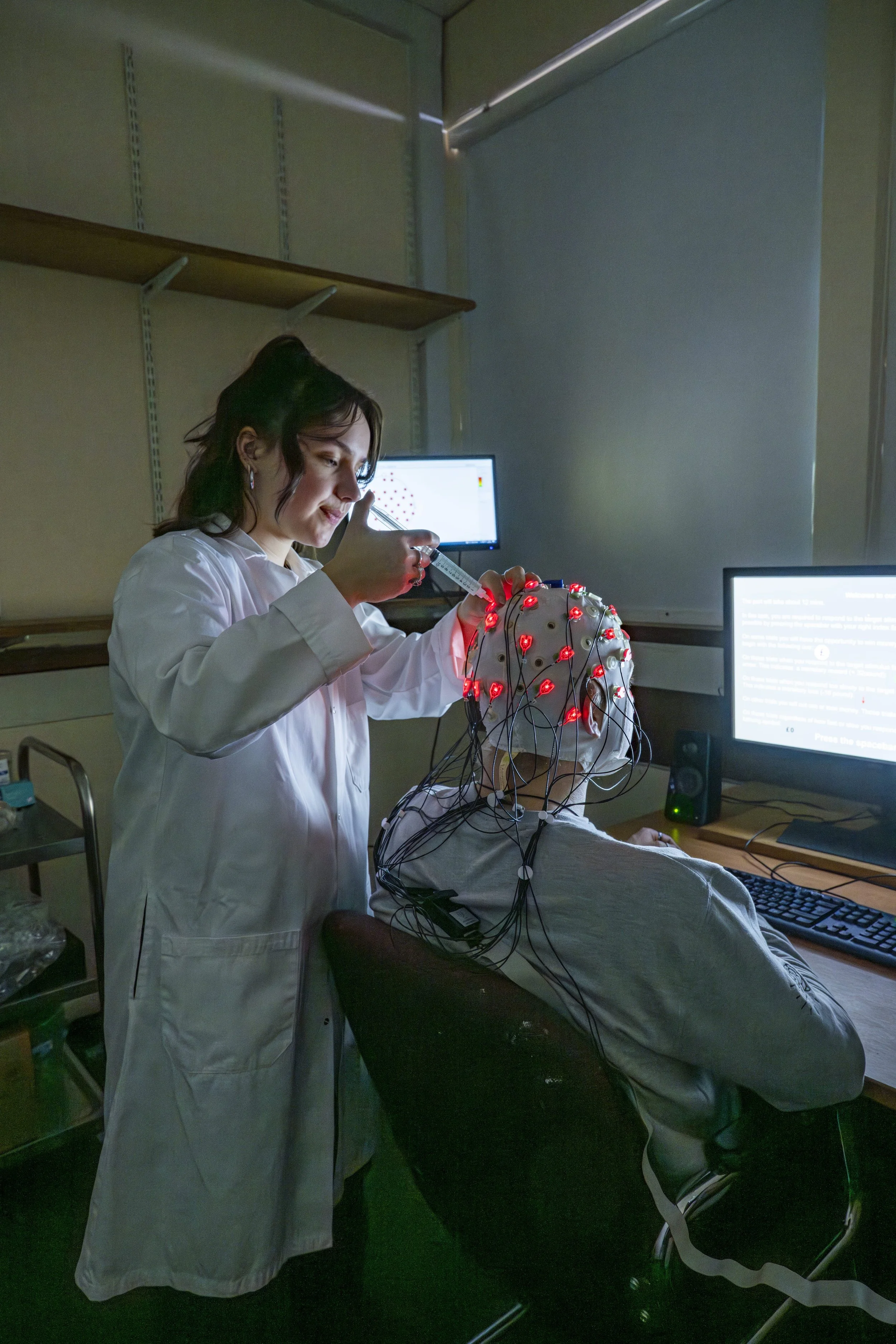
In the Southampton Social Neuroscience Laboratory we use neuroscientific tools (EEG, fMRI, brain stimulation) to address questions traditionally of interest to social psychologists and develop neuroscientific theories that explain the biological basis of variation in human personality and social behaviour.
As part of the Centre for Research on Self and Identity, we are broadly interested in the neural basis of the representational self (how identity is represented in the mind and brain), the executive self (how identity influences decision-making), and the relational self (how identity shapes social bonds).
Our work on the representational self examines how different aspects of identity are represented, evaluated, and processed in the brain. A major focus of this work is authenticity. We investigate how the authentic self differs from other self-representations. We also examine how these representations shape self-relevant information processing and engage neural systems involved in self-reference and reward.
Our work on the executive self examines how identity and individual differences shape self-regulation, learning, and decision-making. We study how self-control influences reward-related brain function and how personality traits such as narcissism shape neural responses to errors, feedback, rewards, and other information that guides behaviour.
Our work on the relational self examines how relationships and social experiences shape brain function and social behaviour. We study how early childhood experiences and the attachment system influence neural responses to social reward and threat. We also examine how people coordinate, influence, and align with others during social interaction, including in leadership and group decision-making contexts.
These themes capture much of our work, but our research extends more broadly across social and affective neuroscience, including the neural basis of social cognition, social emotions, personality, and existential psychological processes.